Welcome to the California Reforestation Toolshed
Discover Resources for Your Reforestation Projector
Not exactly sure what you’re looking for? Try our exploratory search below!
Join your reforestation-focused peers on Slack!
Did you know that there is an online space for active information exchange about reforestation in California? For up-to-date information and to join the conversation about upcoming events, projects, open positions, community-of-practice discussions, and other opportunities, please join in and contribute!
 Join Us On Slack
Monday October 05, 2026
Shelley Villalobos
:man-raising-hand:Volunteer Day at USFS Placerville nursery 🌱- Oct 17 8am-12pm - Volunteers will spend the morning removing weeds from the site's outdoor grow areas and will end their day with a staff-led tour to learn about the nursery and its role in seed management and forest restoration.
Tuesday September 22, 2026
Shelley Villalobos
We have an exciting agenda this year which we hope will facilitate timely conversations and open up new learning & partnership opportunities for folks in the room. We’ll explore turning reforestation need into demand, scaling implementation, science-informed decision-making, co-stewardship, biomass utilization, and reforestation for multiple values.
As usual, your participation and voice are both wanted and needed there - we're all in this together. And since this group on Slack is already engaged with the RPP in some way/shape/form, we want to honor that - please use the coupon code RETURNER at checkout for $50 off (25% off the registration fee).
Looking forward to seeing many of you down at the valley's edge of the southern Sierra Nevada range, and home to some of the world's most iconic forest lands!
Thursday August 27, 2026
Shelley Villalobos
:chipmunk: NOMINATIONS OPEN NOW FOR 2026 CALIFORNIA SQUIRREL AWARDS! 🏆
The 3rd annual California Squirrel Awards will recognize the outstanding efforts of cone hunters, climbers, ground crew, and 'hidden champions' of any and all affiliations who are helping collect the seed needed for future forests. Nominate a friend, peer, or colleague before Sept. 25!
The awards will be presented at the 2026 Understory Conference, Oct. 21-22 in Visalia! NOMINATION FORM HERE





Peer-Reviewed Publications
A horizon scan to inform research priorities on post-wildfire forest restoration and recovery in the western United States
This peer-reviewed publication used a standardized expert-elicitation process to identify key topics for post-fire forest restoration and recovery in the near future. The study identified 12 topics as the most urgent and with the greatest potential impact.

Peer-Reviewed Publications
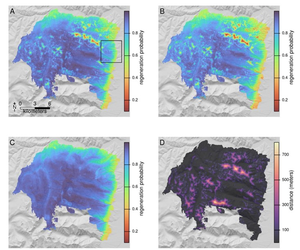
A post-fire reforestation assessment and prioritization tool for the Western United States
This paper discusses how Regenmapper, a decision support tool, can assist in assessing and prioritizing post-fire reforestation efforts, particularly in response to challenges such as drought, climate change, and wildfires.
Peer-Reviewed Publications
A spatial triage of at-risk conifer forests to support seed collection efforts and sustainable forestry
Finding and collecting seeds from trees living in hot and arid conditions can support collecting and making climate adapted seeds available for sustainable forestry. This study uses a triage framework to identify high-priority areas to survey for Ponderosa pine cone collection by intersecting an updated range map with seed zones and elevation bands
Frameworks and Manuals
Adaptation Strategies and Approaches for California Forest Ecosystems
This workbook offers land managers a menu of adaptation strategies, offering flexible, yet tangible, options for considering climate change when managing California's forests. It reflects the context of the state's forests and is informed by a synthesis of California forest adaptation literature. It is intended to be used within the Adaptation Workbook, which presents a five-step framework to incorporate effects of climate change on forests into planning, decision-making, and implementation.

Programs
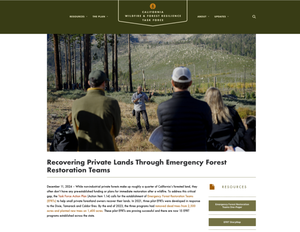
California Emergency Forest Restoration Teams
In response to the 2021 Dixie, Tamarack, and Caldor fires, three emergency forest restoration teams (EFRTs) were formed to rapidly assist private landowners in restoring their forests' health. Today, 15 EFRT programs work across the state to provide no-cost post-disturbance technical assistance to landowners, including mechanical site preparation, reforestation, and post-planting maintenance.

Programs
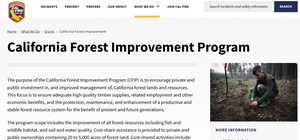
California Forest Improvement Program
The CA Forest Improvement Program provides technical and cost-share assistance forest landowners who want to improve the health of their land and resources. Assistance is available to public and privately owned parcels from 20 - 5,000 acres in size, for reforestation and stand improvement activities.
Decision-Support Tools
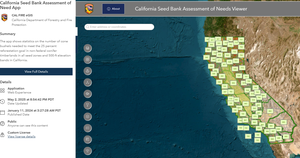
California Seed Bank Assessment of Need App
This app provides users with a spatial summary of cone bushels needed in each seed zone to meet the state of California's reforestation goals. Statistics for each seed zone reflect collection priority, recent disturbances, and the need or surplus for each speciees.

Peer-Reviewed Publications
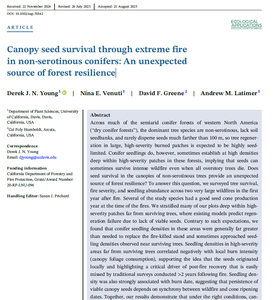
Canopy seed survival through extreme fire in non-serotinous conifers: An unexpected source of forest resilience
In this study, researchers explored natural regeneration in non-serotinous conifers occurring via seeds that survived in the canopy of fire-killed trees. The authors found multiple lines of evidence suggesting seeds did survive in the canopy of these trees and successfully regenerated into seedlings, especially if fire occurred late in summer, when seeds were ripe but still within cones.
Peer-Reviewed Publications
Challenges to the Reforestation Pipeline in the United States
This peer-reviewed publication imagines a scenario where by 2040, 26 million hectares of natural and agricultural lands are reforested with 30 billion trees at a cost of $33 billion USD. Through this example, the authors evaluate the ecological and operational challenges today that would stand in the way of acheiving that imagined future.
Frameworks and Manuals
Climate Change and Forests of the Future: Managing in the Face of Uncertainty
Climate change threatens the health of forests, but land managers must make decisions today without knowing exactly what the future will look like. This framework helps land managers make the best decisions possible in the face of uncertainty, detailing a varierty of climate adaptation and mitigation strategies that managers could take and emphasizing the importance of reversible and incremental actions.
Decision-Support Tools
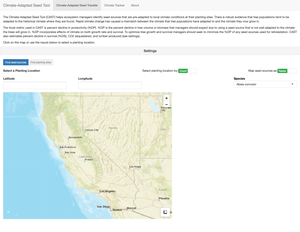
Climate-Adapted Seed Tool (CAST)
Trees are experiencing higher mortality and lower growth rates as climate change affects their native ranges. Many land managers are interested in assisted migration as a solution. This decision-support tool helps land managers identify potential seed sources by comparing the current climate of a tree's natural range to the projected future climate (under RCP 8.5) of the user's desired planting site. Users can view data on the potential productivity of six conifer species from now until 2080.
Peer-Reviewed Publications
Comparison of Organic and Chemical Soil Amendments Used in the Reforestation of a Harsh Sierra Nevada Site
This peer-reviewed publication compares the effects of three soil amendments—an organic amendment, a chemical fertilizer, and a mycorrhizal inoculation—on the establishment of barefoot Jeffrey pine seedlings. The chemical fertilizer increased seedling growth by 78% compared to control conditions, while the mycorrhizal inoculation had no effect on growth. The organic amendment decreased growth compared to control conditions, likely due to impaired water relations.

Frameworks and Manuals
Cone Hunting 101
Online course to learn the basics of how to identify common native California conifers, how cones are made, how to cone survey, cone monitor, and support cone collections.
Peer-Reviewed Publications
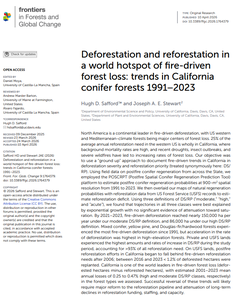
Deforestation and reforestation in a world hotspot of fire-driven forest loss: trends in California conifer forests 1991–2023
Peer-reviewed publication quantifying reforestation needs across California, 1991 - 2023. Describes how field data were used to refine the POSCRPT tool model. Proposes reforestation needs in three-tiered priority bins, with moderate priority considering just burn severity, and high and acute priority tiers considering the combination of burn severity and natural regeneration potential. Presents results in terms of forest types as well as seed zones.
Peer-Reviewed Publications
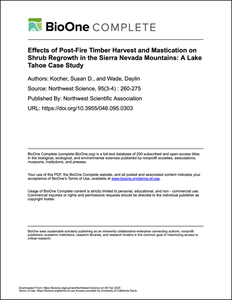
Effects of Post-Fire Timber Harvest and Mastication on Shrub Regrowth in the Sierra Nevada Mountains: A Lake Tahoe Case Study
This case study evaluates the effectiveness of an experimental site preparation practice implemented in South Lake Tahoe, CA: the mastication and spreading of unmerchantable biomass on over 1,000 hectacres of postfire forested land. The practice proved to be effective at preventing erosion, reducing drought stress, and controlling understory shrub regrowth.